
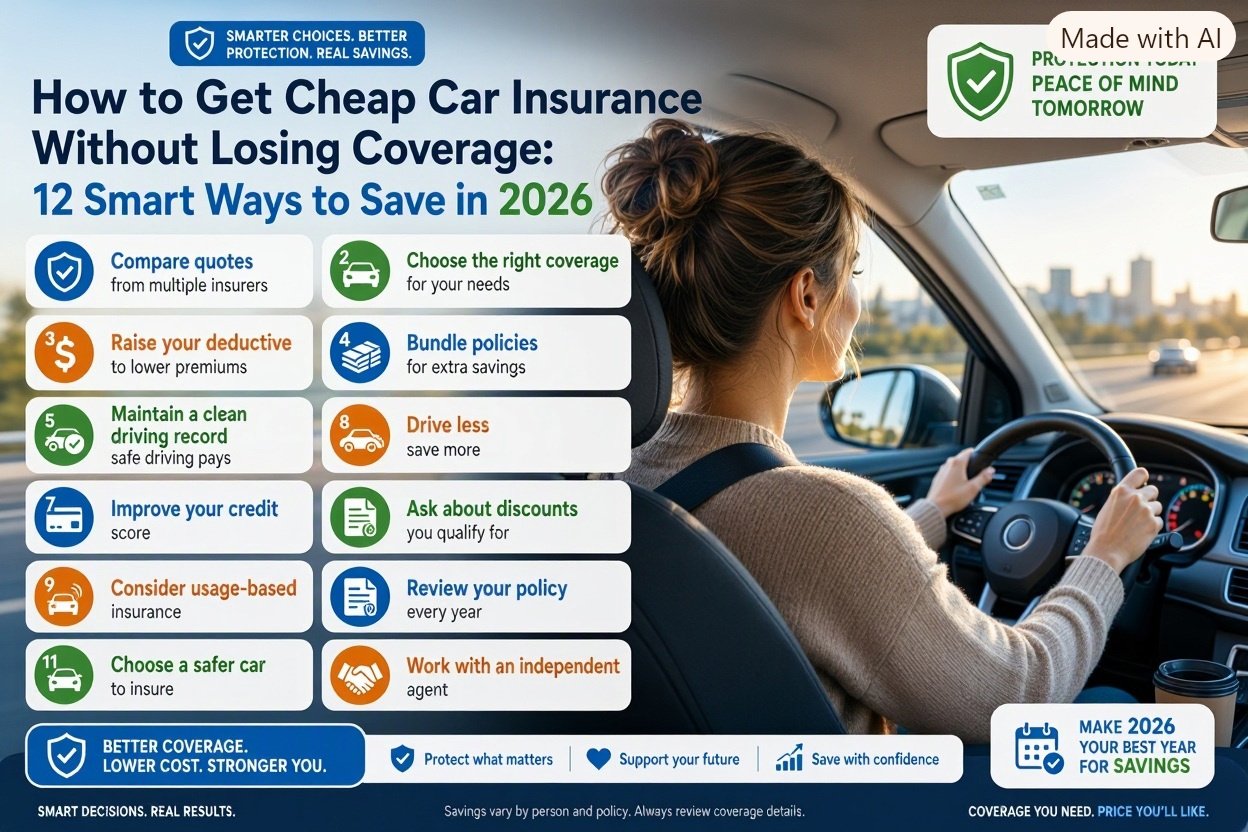
Car insurance is an important part of owning a vehicle, but paying expensive premiums every year can put pressure on your budget. Whether you’re a new driver or have been driving for years, you probably want the same thing: reliable protection at an affordable price.
The good news is that getting cheaper car insurance doesn’t always mean reducing your coverage. In many cases, you can lower your premium by comparing insurers, finding discounts, adjusting your deductible, and making smarter decisions about your policy.
The key is knowing where you can save money without exposing yourself to unnecessary financial risks.
In this guide, we’ll explain 12 practical ways to get cheap car insurance without losing important coverage, common mistakes to avoid, and how to choose a policy that fits your needs.
Why Is Car Insurance So Expensive?
Before looking for ways to save, it helps to understand what affects your car insurance premium.
Insurance companies consider several factors when calculating the cost of your policy.
These may include:
- Your age: Younger and less experienced drivers may pay higher premiums in some markets.
- Driving history: Accidents, traffic violations, and previous claims can affect your price.
- Vehicle type: Expensive cars and vehicles with costly replacement parts may cost more to insure.
- Location: Traffic conditions, theft rates, weather risks, and repair costs can influence premiums.
- Coverage limits: Higher protection limits generally increase the premium.
- Deductible: Choosing a higher deductible may reduce your insurance cost.
- Annual mileage: Driving fewer miles may qualify you for certain discounts.
- Insurance history: A continuous insurance record may help you qualify for better rates with some providers.
Understanding these factors helps you identify which parts of your insurance cost you can actually control.
12 Smart Ways to Get Cheap Car Insurance Without Losing Coverage
You don’t need to immediately remove important benefits from your policy to save money. Start with these practical strategies.
1. Compare Quotes From Multiple Insurance Companies
One of the easiest ways to find cheaper car insurance is to compare prices from different providers.
Insurance companies don’t always calculate premiums in the same way. One insurer may offer a lower price for your vehicle and driving history, while another may charge considerably more for similar protection.
Instead of automatically renewing your current policy, request quotes from at least three to five insurance companies.
When comparing them, make sure each quote includes similar:
- Liability coverage limits.
- Collision and comprehensive protection.
- Deductibles.
- Personal accident or medical benefits.
- Optional coverage.
- Policy conditions and exclusions.
For example, imagine your current insurer charges $1,200 annually for a policy. Another company offers the same major coverage for $950.
That could save you $250 per year without reducing your protection.
The important thing is to compare the actual policy benefits, not just the final price.
2. Ask Your Insurance Company About Every Available Discount
Many drivers pay more than necessary because they don’t ask about discounts.
Insurance companies may offer savings for different reasons, depending on their pricing rules and the country where you live.
Some common discounts include:
Safe Driver Discount
Drivers with a clean driving history may qualify for lower premiums.
Avoiding accidents and traffic violations can help demonstrate responsible driving.
Multi-Car Discount
If your household owns multiple vehicles, insuring them with the same company may qualify you for a discount.
Multi-Policy Discount
Some insurers offer lower prices when customers purchase more than one insurance product from them.
For example, combining car insurance with home or renters insurance may reduce the overall cost.
Always compare the combined price with separate policies to make sure you’re actually saving money.
Student Discount
Certain insurers offer discounts to eligible students who maintain good academic performance.
The requirements vary between companies.
Anti-Theft Device Discount
Installing an approved alarm, immobilizer, or tracking device may reduce your premium with some insurers.
Ask your provider which security features qualify.
Paperless Billing and Automatic Payments
Some insurance companies offer small discounts for electronic documents, automatic payments, or paying the annual premium in one installment.
These savings aren’t available everywhere, so check with your provider.
3. Choose a Higher Deductible If You Can Afford It
Your deductible is the amount you agree to pay toward a covered claim before your insurance company pays the remaining eligible amount.
Choosing a higher deductible can reduce your insurance premium.
For example:
| Policy option | Deductible | Annual premium |
|---|---|---|
| Option A | $250 | $1,200 |
| Option B | $500 | $1,100 |
| Option C | $1,000 | $980 |
These figures are illustrative, not actual insurance quotes.
In this example, choosing the $1,000 deductible saves $220 annually compared with Option A.
However, there’s an important consideration.
If your car is damaged, you must be able to afford the higher deductible before receiving the insurer’s payment.
Practical tip: Choose a deductible that you could comfortably pay from your emergency savings. Don’t accept a large deductible just to get a lower monthly premium.
4. Maintain a Clean Driving Record
Your driving behavior can influence how much you pay for car insurance.
Accidents and traffic violations may increase your premiums, depending on the insurer’s rules and local regulations.
You can help protect your driving record by:
- Following speed limits.
- Avoiding distracted driving.
- Maintaining a safe distance.
- Using indicators correctly.
- Wearing your seat belt.
- Avoiding aggressive driving.
- Never driving under the influence.
- Following traffic signals and road signs.
Some insurers also offer safe-driving programs that monitor driving habits through an app or a device installed in your vehicle.
These programs may reward careful driving with discounts.
However, check what information is collected and how it affects your premium before enrolling.
5. Consider Usage-Based or Low-Mileage Insurance
Do you drive only a few days a week?
Perhaps you work from home, use public transportation, or mainly use your car for short trips.
If you drive fewer miles than the average motorist, you may qualify for a low-mileage discount or a usage-based insurance plan.
These policies may calculate part of your premium based on:
- Annual mileage.
- Driving frequency.
- Time spent on the road.
- Braking habits.
- Acceleration.
- Driving speed.
Some programs charge according to how much you drive, while others use driving behavior to calculate discounts.
This option can be particularly useful for people who don’t use their vehicles every day.
However, make sure you understand the privacy policy and whether poor driving scores could increase your premium.
6. Review Your Policy for Unnecessary Add-Ons
Many car insurance policies offer optional benefits that can increase the total premium.
Some may be useful, but others may not match your driving habits or financial needs.
Common add-ons include:
- Roadside assistance.
- Rental car reimbursement.
- Extended windscreen coverage.
- Personal belongings coverage.
- Additional accident benefits.
- New car replacement coverage.
For example, if you already receive roadside assistance through a separate membership, purchasing the same benefit again may be unnecessary.
Review each additional feature and ask yourself whether you genuinely need it.
Don’t remove protection simply because it costs extra. Remove only benefits that provide little value or duplicate protection you already have.
7. Bundle Your Insurance Policies
Bundling means purchasing multiple insurance products from the same provider.
Some companies offer discounts when customers combine policies.
For example, you might be able to combine:
- Car insurance.
- Home insurance.
- Renters insurance.
- Motorcycle insurance.
- Other eligible insurance products.
The advantage is that you may receive a lower combined premium and manage multiple policies through one company.
However, bundling isn’t automatically the cheapest option.
Compare the total cost of bundled coverage against buying each policy separately. Make sure the discount doesn’t come at the expense of weaker protection.
8. Choose Your Vehicle Carefully
The type of car you drive can make a significant difference to your insurance cost.
Some vehicles are more expensive to insure because they have higher repair costs, expensive replacement parts, or greater theft risks.
Before purchasing a vehicle, research its typical insurance cost.
Consider these factors:
- Vehicle market value.
- Repair and maintenance expenses.
- Availability of spare parts.
- Safety features.
- Theft risk.
- Engine size and performance.
- Replacement cost.
A reliable, reasonably priced vehicle may be less expensive to insure than a luxury or high-performance model.
If you’re planning to buy your first car, compare insurance costs before making the final purchase.
9. Improve Your Vehicle’s Security
Vehicle theft can create major financial losses, particularly if your policy doesn’t include suitable theft protection.
Improving your car’s security may help reduce risk and could qualify you for a discount with certain insurers.
Consider installing:
- An approved car alarm.
- An immobilizer.
- A GPS tracking system.
- A steering wheel lock.
- Additional security features recommended by your insurer.
Parking in a secure garage or monitored parking area may also help reduce theft and damage risks.
Before spending money on security equipment, ask your insurance provider which devices are approved and whether they offer any premium reductions.
10. Pay Your Premium Annually If It Saves You Money
Some insurers allow customers to pay monthly, quarterly, or annually.
Monthly payments can make budgeting easier, but they may involve installment fees or additional charges.
If your insurance company offers a discount for paying the full annual premium, compare the total cost of both options.
For example:
| Payment method | Total yearly cost |
|---|---|
| Monthly installments | $1,080 |
| Annual payment | $1,000 |
In this illustration, paying annually saves $80.
However, don’t use all your emergency savings just to receive a small discount. Choose the payment method that works best for your financial situation.
11. Maintain Continuous Insurance Coverage
Avoid allowing your car insurance policy to expire without arranging replacement coverage.
A gap in insurance may create legal problems if you drive without required protection. It can also affect future premiums because some insurers consider continuous coverage when calculating rates.
To avoid interruptions:
- Check your renewal date.
- Set a reminder before the policy expires.
- Compare renewal quotes early.
- Arrange your new policy before canceling the old one.
- Keep proof of active coverage.
Some insurers offer discounts for maintaining continuous insurance, although availability varies.
12. Review Your Coverage Every Year
Your insurance needs can change over time.
You may move to another location, drive fewer miles, purchase a different vehicle, or pay off your car loan.
These changes could affect the price of your policy.
Review your insurance at least once a year and ask your provider whether your current coverage still makes sense.
Check:
- Whether your vehicle’s value has decreased.
- Whether your annual mileage has changed.
- Whether you qualify for new discounts.
- Whether your deductible is still affordable.
- Whether your coverage limits remain appropriate.
- Whether any optional benefits are no longer necessary.
The goal is to keep suitable protection while removing unnecessary expenses.
What Coverage Should You Never Reduce Just to Save Money?
Getting a cheaper policy is important, but some coverage reductions can create serious financial risks.
Here are a few areas where you should be especially careful.
1. Don’t Reduce Liability Coverage Too Much
Liability insurance helps protect you financially if you cause an accident that injures someone or damages their property.
A serious accident can involve expensive medical bills, vehicle repairs, and legal costs.
If your liability limits are too low, you may have to pay some expenses yourself.
Choose limits that reflect the risks you could realistically face and the financial assets you need to protect.
2. Don’t Remove Collision Coverage Without Considering Your Car’s Value
Collision coverage can help pay for eligible damage to your vehicle after an accident.
If you depend on your car and cannot afford to repair or replace it, removing this protection could be a costly decision.
Before dropping collision coverage, compare the premium with your vehicle’s current value and your ability to handle a major loss.
If your car is financed or leased, your lender may require collision coverage.
3. Don’t Remove Comprehensive Coverage Without Understanding the Risks
Comprehensive insurance may protect your vehicle against theft, fire, certain weather damage, vandalism, and other non-collision events.
If you live in an area with significant theft, flooding, or severe weather risks, removing this protection could leave you exposed.
Consider the replacement cost of your car before making changes.
4. Don’t Choose a Deductible You Cannot Afford
A higher deductible may lower your premium, but it also increases your financial responsibility when you make a claim.
Keep your deductible within an amount you can comfortably pay.
Saving money every month isn’t helpful if you cannot afford to use your insurance when something goes wrong.
How to Compare Car Insurance Quotes Properly
Comparing quotes is one of the most effective ways to find affordable coverage.
But comparing prices alone isn’t enough.
Use this simple process:
Step 1: Gather Your Vehicle Information
Prepare your:
- Vehicle make and model.
- Manufacturing year.
- Registration details.
- Current market value.
- Annual mileage.
- Driving history.
Step 2: Decide What Coverage You Need
Determine whether you need liability, collision, comprehensive, personal accident, or additional benefits.
Check your local legal requirements and any lender conditions.
Step 3: Request Multiple Quotes
Contact several insurance companies and request quotes using the same coverage limits and deductibles.
Step 4: Compare the Policy Details
Look beyond the premium.
Check exclusions, claim conditions, repair arrangements, deductibles, and coverage limits.
Step 5: Ask About Discounts
Ask every insurer whether you qualify for safe-driver, low-mileage, multi-policy, anti-theft, or payment discounts.
Step 6: Check the Company’s Reputation
Research the insurer’s financial strength, claims process, customer support, and regulatory status.
A slightly cheaper policy may not be worth choosing if the company has poor claims service or unclear policy conditions.
Car Insurance Savings: A Practical Example
Imagine you currently pay $1,500 per year for car insurance.
After reviewing your policy, you discover several opportunities to reduce the cost.
| Cost-saving action | Illustrative annual saving |
|---|---|
| Switching to a comparable lower-priced insurer | $180 |
| Qualifying for a safe-driver discount | $100 |
| Receiving an approved security-device discount | $50 |
| Paying annually instead of in installments | $40 |
| Total potential saving | $370 |
Your new annual premium could be $1,130 instead of $1,500, assuming all discounts are available and the quoted coverage remains identical.
These numbers are examples only. Actual savings depend on the insurer, vehicle, location, and policy.
The important lesson is that you may be able to reduce your insurance bill without removing important protection.
Cheap Car Insurance in Pakistan: What Should Drivers Know?
If you live in Pakistan, you should compare motor insurance options based on your vehicle’s value, location, driving habits, and financial requirements.
Insurance products and prices vary between companies.
Here are some practical ways to manage the cost:
Compare Third-Party and Comprehensive Insurance
Third-party insurance generally covers certain liabilities toward other people.
Comprehensive motor insurance offers broader protection and may include accidental damage, theft, fire, and other specified risks.
Choose coverage based on your financial situation and the risks you want to protect against.
Check Your Vehicle’s Insured Value
Make sure the declared vehicle value is accurate.
If the insured value is too low, you may receive less compensation than expected after a major loss.
Ask the insurer how depreciation and market value affect claims.
Ask About Available Discounts
Contact different insurance providers and ask whether they offer discounts for:
- Vehicle security devices.
- Claim-free history.
- Approved tracking systems.
- Annual premium payments.
- Other qualifying customer benefits.
Not every company offers the same discounts.
Explore Family Takaful Options
If you prefer Shariah-compliant financial protection, compare motor Takaful products.
Review the contribution amount, coverage, exclusions, claims procedure, and other conditions.
Verify the Insurance Provider
Before paying, confirm that the company is authorized to offer the insurance product.
Review the policy documents and keep your payment receipt and insurance certificate.
The Securities and Exchange Commission of Pakistan (SECP) provides regulatory information and consumer resources that can help you understand the insurance market.
Common Mistakes to Avoid When Looking for Cheap Car Insurance
Trying to save money can sometimes lead to poor insurance decisions.
Avoid these mistakes:
Choosing the Cheapest Policy Without Comparing Coverage
A low premium may come with lower limits, higher deductibles, or important exclusions.
Always compare similar policies.
Reducing Liability Limits Too Much
This can leave you responsible for substantial expenses after a serious accident.
Make sure your liability coverage is appropriate for your situation.
Providing Incorrect Information
Never misrepresent your driving history, vehicle details, mileage, or vehicle usage.
Incorrect information can cause problems during the claims process.
Ignoring Policy Exclusions
Read the contract carefully so you understand what is and isn’t covered.
Missing Your Renewal Date
An expired policy can leave you without protection and may create legal issues if you continue driving.
Not Checking the Claims Process
Before buying, understand how to report an accident and what documents the insurer requires.
Frequently Asked Questions About Cheap Car Insurance
1. How Can I Get Cheaper Car Insurance Without Reducing Coverage?
Compare quotes from multiple companies, ask about discounts, maintain a clean driving record, consider annual payment options, and check whether you qualify for low-mileage or usage-based insurance.
These steps may reduce your premium without removing important coverage.
2. Does Increasing My Deductible Lower My Insurance Premium?
Yes, choosing a higher deductible may reduce your premium.
However, you will have to pay more out of pocket when making a covered claim. Only choose a deductible you can afford.
3. Is It Better to Pay Car Insurance Monthly or Annually?
It depends on the insurer’s payment fees and discounts.
Annual payments may cost less overall, while monthly installments can make budgeting easier.
Compare the total yearly cost before deciding.
4. Can I Get a Discount for Safe Driving?
Some insurance companies reward drivers who maintain clean records or participate in approved safe-driving programs.
The discount and eligibility requirements vary by provider.
5. Does Having an Anti-Theft Device Reduce Car Insurance Costs?
Some insurers offer discounts for approved alarms, immobilizers, or tracking devices.
Ask your insurer which security features qualify before purchasing equipment.
6. How Often Should I Compare Car Insurance Quotes?
A good habit is to compare quotes at every renewal, generally once a year or whenever your policy period ends.
You should also review your options after major changes, such as buying a new car, moving, or reducing your annual mileage.
7. Should I Remove Comprehensive Coverage to Save Money?
Not automatically.
Consider your vehicle’s current value, theft risk, local weather conditions, and ability to replace the car if it is stolen or badly damaged.
If you cannot afford a major loss, keeping comprehensive coverage may be worthwhile.
8. Can I Switch Car Insurance Companies Before My Policy Expires?
In many markets, you can cancel or switch before the renewal date, but cancellation fees, refund rules, and notice requirements may apply.
Check your existing contract and arrange replacement coverage before ending the old policy.